



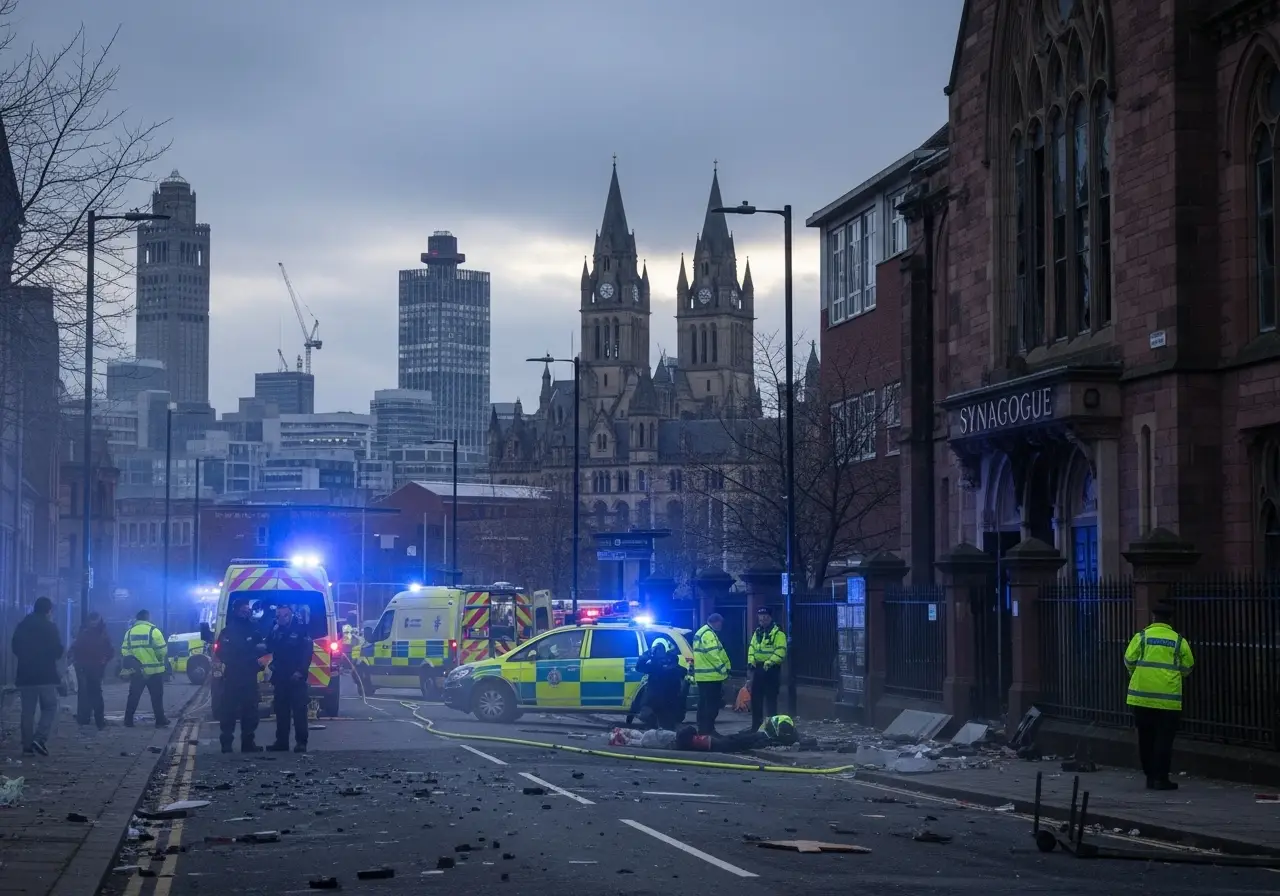
A brutal attack outside the Heaton Park Hebrew Congregation synagogue in Manchester has shaken the UK’s Jewish community and ignited a nationwide debate on religious safety, counter-terrorism, and rising antisemitism.
On October 3, 2025—Yom Kippur, the holiest day in the Jewish calendar—35-year-old Jihad Al-Shamie, a British citizen of Syrian descent, launched a violent assault on worshippers gathered for prayer. According to eyewitnesses and police reports, Al-Shamie rammed his car into pedestrians before exiting with a knife and attempting to storm the synagogue. Two men were killed, including one accidentally shot by police during the response, and three others were hospitalized with serious injuries.
A Community Shattered
The attack unfolded in Crumpsall, a quiet suburb in north Manchester, where the synagogue has served the Ashkenazi Orthodox community since 1967. Rabbi Daniel Walker, who was leading the service, helped guide congregants to safety as panic spread. Armed officers arrived within minutes and fatally shot the attacker, who was wearing a fake explosive vest.
The victims were identified as Melvin Cravitz, 66, and Adrian Daulby, 53. Daulby’s death, tragically caused by friendly fire, has added complexity to the investigation and raised questions about emergency response protocols.
Terrorism and Extremism
Authorities have classified the incident as a terrorist attack. Investigators discovered extremist materials in Al-Shamie’s residence, including documents echoing Hamas slogans and encrypted communications linked to Islamist hate groups. The suspect, reportedly radicalized following the 2023 Israel-Hamas war, had withdrawn from social life and was under bail for an unrelated criminal charge.
Six individuals have been arrested on suspicion of assisting the attacker, and the case has been handed over to the Metropolitan Police’s counter-terrorism unit.
Rising Antisemitism in the UK
The attack comes amid a disturbing surge in antisemitic incidents across the UK. The Community Security Trust (CST) recorded 1,521 cases from January to June 2025—one of the highest half-year totals on record. These include physical assaults, online abuse, and threats targeting Jewish schools and institutions.
Recent research by the Antisemitism Policy Trust and the Home Office shows that religious hate crimes against Jewish people more than doubled between 2023 and 2024. Jewish leaders have expressed growing concern over the normalization of anti-Jewish rhetoric in public discourse and social media.
Marc Levy, chief executive of the Jewish Representative Council of Greater Manchester, described the attack as “an inevitability,” echoing fears long held by the community. The Board of Deputies of British Jews called the incident “a tragedy we feared was coming.”
National Security Debate Intensifie
The Manchester attack has reignited debate over the UK’s preparedness to prevent religiously motivated violence. Critics argue that current surveillance and community protection measures are insufficient, especially given the rise in lone-wolf radicalization and encrypted digital communication.
Prime Minister Keir Starmer visited the scene and pledged to review national security protocols. “We must ensure that every community feels safe in their place of worship,” he said. Proposals under discussion include increased funding for synagogue security, enhanced intelligence sharing, and stricter monitoring of online extremist content.
A Call for Unity and Action
As mourners gathered outside the synagogue, the scent of rain-soaked flowers mingled with grief and resolve. Community leaders urged solidarity and swift action to prevent future tragedies.
“This was not just an attack on Jews—it was an attack on the values of tolerance and peace that define our society,” said Rabbi Walker. “We must respond not with fear, but with unity and vigilance.”
